
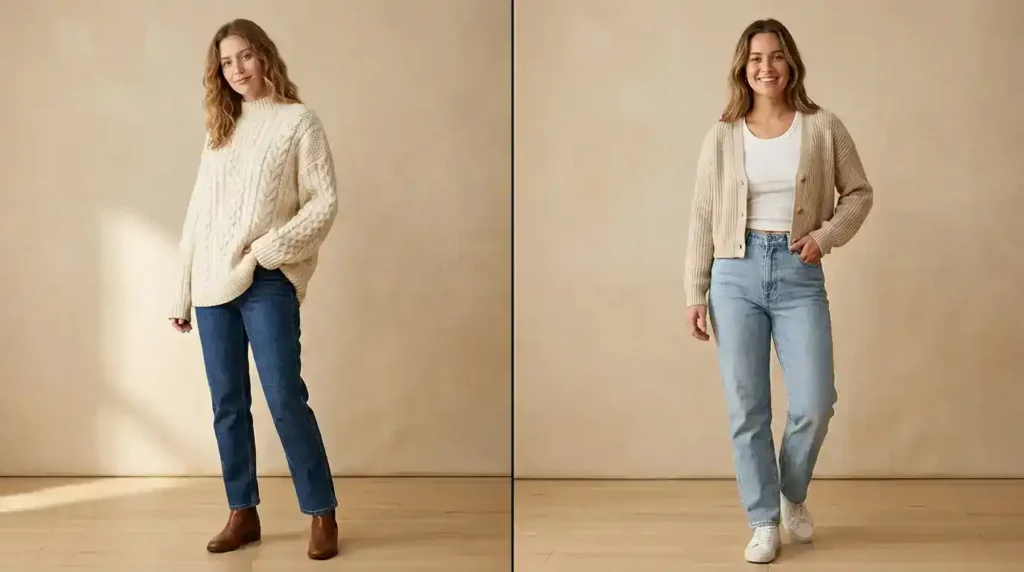
For most people, cardigans are the better choice for layering. You put one on. You take one off. Your blowout stays perfect, and your outfit adapts to the day’s temperature. Sweaters are better for warmth. A closed knit holds heat, while an open-front piece lets it escape.
This comparison of sweaters vs cardigans uses recent retail data from five knitwear sellers. It also has fit checks for cropped cardigans, oversized sweaters, and cable-knit crewnecks. I checked prices this week, not last season. So, the numbers below show what you will pay right now. A premium cashmere pullover from a brand like Naadam runs $250 to $700. A high-end cardigan set from a brand like Arket averages $120 to $200 for a comparable weight of wool.
Sweaters work best for the person who wants one grab-and-go piece with zero fuss. Cardigans work best for the person who layers through a workday, a commute, or a climate that swings ten degrees before lunch.
Cardigans outshine sweaters for layering. The open front helps you manage warmth without taking off your top layer completely. The Everlane Cotton Cardigan ($98) is the pick for daily wear. The Quince Mongolian Cashmere Crewneck Sweater ($96) is the pick if you want raw warmth for less money. Buy the cardigan for the office, the sweater for the couch.
Sweaters vs Cardigans at a Glance

| Feature | Sweaters | Cardigans | Winner |
|---|---|---|---|
| Warmth per layer | Closed-knit, higher thermal insulation | Open front, some heat escapes | Sweaters |
| Layering ease | Must pull on/off over the head | Slides on like a jacket | Cardigans |
| Average price (wool blend) | $60–$180 | $70–$200 | Tie |
| Styling flexibility | Great as a standalone piece | Works over shirts, dresses, tanks | Cardigans |
| Hair and makeup friendly | No mussed hair on removal | Yes, a head-pulling is required | Cardigans |
What Makes the Sweater Stand Out?

A sweater is a closed-knit garment, no gaps, no buttons, nothing to secure. That single detail explains almost everything about how it performs. Heat has nowhere to escape, so the same gauge of yarn feels warmer in sweater form than it does in a cardigan cut from the exact same fabric.
Cable knit sweaters push this further. The raised, twisted stitch pattern adds bulk. This traps more air and improves thermal insulation per square inch. An oversized sweater goes further. The extra fabric traps warm air against your body, like a cozy blanket.
The trade-off shows up the moment you get too warm. You cannot crack a sweater open at your desk. You pull the whole thing off, static included, hair not included in the deal you signed up for. That one flaw drives many buyers to choose cardigans for indoor wear or uncertain weather.
Sweaters still win on simplicity. One piece, one silhouette, no buttons to lose, and no placket to gap open at the chest. For weekends, travel days, or when you want to dress quickly, a sweater is perfect. It cuts down on decision fatigue better than almost anything else in your closet.

What Makes the Cardigan Stand Out?

A cardigan is a sweater with a button placket down the front, and that one design choice changes its entire job description. The open-front style lets you take it off in seconds. That’s why cardigans are a staple in office wardrobes and seasonal closets.
Cropped cardigans fill a styling need. They work well with high-waisted pants, dresses, and skirts. A full-length sweater can hide the waistline, but cropped cardigans keep it visible. Longer cardigans for women serve as a great coat replacement. On a 55-degree day, a real coat might feel too heavy, while a sweater can seem too light.
The sweater vest also deserves attention. It uses the cardigan’s layering idea but without sleeves. It fits neatly under a blazer or over a collared shirt. That layering-first design is the throughline across the whole cardigan family, vest included.
The flaw no one talks about: buttons pop, plackets gap at the bust on fuller figures, and a cheap cardigan can lose shape quickly if the knit is too thin. Check the ply count before you buy. A low ply count in a bargain cardigan means pilling within a few wears, no matter how nice the color looks on the hanger.

The Head-to-Head Showdown

Cost
A wool-blend sweater and a wool-blend cardigan land in a similar price band most of the time, roughly $60 to $200 depending on fiber content. Cashmere changes the math fast. A pure cashmere pullover from a brand can cost $700. In contrast, a similar cardigan set usually costs $120 to $200 less. This is because cardigans often use cotton and wool blends instead of pure cashmere.
Cost Winner: Cardigans – you get more layering use out of a lower average price point.
Warmth and Comfort
Closed knits win on raw heat retention every time you test them side by side. A cable-knit sweater at the same gauge as a cardigan will feel measurably warmer because there’s no placket gap for heat to leak through.
Warmth Winner: Sweaters – the closed construction traps more body heat, full stop.
Layering Versatility
This is the whole point of the comparison, and it isn’t close. A cardigan slides over a tank top, a collared shirt, or a dress without disturbing anything on your head or face. A sweater requires a full removal, hair static and all, every single time your body temperature shifts.
Versatility Winner: Cardigans – on/off ease is not a small feature; it’s the entire use case.
Styling Range
Sweaters read as a finished outfit on their own. Cardigans are great layers. They help you make the most of what you already own. For example, a plain tee under a cropped cardigan works much better than the tee on its own.
Styling Winner: Cardigans – more outfit combinations per single garment.
Durability and Maintenance
Buttons are a failure point that cardigans carry that sweaters simply don’t have. A dropped button, a stretched placket, a gap that won’t lie flat anymore—these show up on cardigans first. Sweaters pill at the underarms and cuffs too. This flaw also affects their lifespan.
Durability Winner: Tie – both fail in different spots at a similar rate over a similar timeline.
Where Both Options Fall Short

Sweaters trap heat you sometimes don’t want trapped. Walk into a hot office wearing a heavy cable knit, and you’ll be stuck sweating. You’ll want to peel it off completely, hair and all. Oversized sweaters hold in heat. This is nice in January, but not so great in a crowded subway in October.
Cardigans have their own weak spot: the button placket. Cheap cardigans often have issues. They may gap open at the bust, and buttons might not align well on fuller chests. Plus, a placket that won’t lay flat can ruin the silhouette, even if the knit feels good underneath. Cropped cardigans often have short sleeves for taller people. Brands usually don’t mention this fit issue on their size charts.
Neither option solves the pilling problem long-term. Low-ply, budget yarn pills within a season regardless of which silhouette you buy. Check the fiber content tag before checkout, not after the first wash.
When to Choose Which Sweaters vs Cardigans

Choose a Sweater if:
- ✅ You want one warm piece with zero styling decisions
- ✅ You’re headed somewhere cold and staying there (outdoor errands, cold commutes)
- ✅ You like the finished, single-garment look without a layer underneath
- ✅ You want a cable-knit sweater as the visual focal point of the outfit
Choose a Cardigan if:
- ✅ Your day includes indoor and outdoor temperature swings
- ✅ You need to layer over dresses, tanks, or button-downs
- ✅ You want a cropped cardigan to pair with high-waisted bottoms
- ✅ Hair and makeup matter, and you can’t pull knitwear over your head at 2 p.m.
Conclusion
Cardigans win the layering fight. The open-front style provides a benefit that sweaters don’t: you can adjust warmth easily. No need to change outfits in a bathroom stall. That one functional edge is worth more than the extra warmth from a closed sweater. This matters for anyone whose day doesn’t stay the same temperature from morning to night.
Sweaters still earn a permanent spot in the closet. Cold, static days need a cable-knit sweater over a cardigan. Nothing beats a close-knit for warmth when you don’t want to layer.
FAQs about Sweaters vs Cardigans: Which one is Best
No. A closed sweater traps more heat than an open-front cardigan of the same weight because there is no placket gap letting warm air escape.
Yes, it’s often the best office choice. You can easily remove a layer without messing up your hair or makeup.
Yes. Cropped cardigans are a must-have. They pair well with high-waisted jeans, trousers, and skirts in today’s fashion.
A sweater vest drops the sleeves but keeps the button-front layering function, making it a lighter, more compact version of a cardigan.
Cardigans work better for fall because temperatures swing between morning and afternoon. The open front lets you regulate warmth without removing your whole top layer, which a sweater can’t do once buttoned up in body heat.
By Sheila D Adam | Independently researched and tested products


