
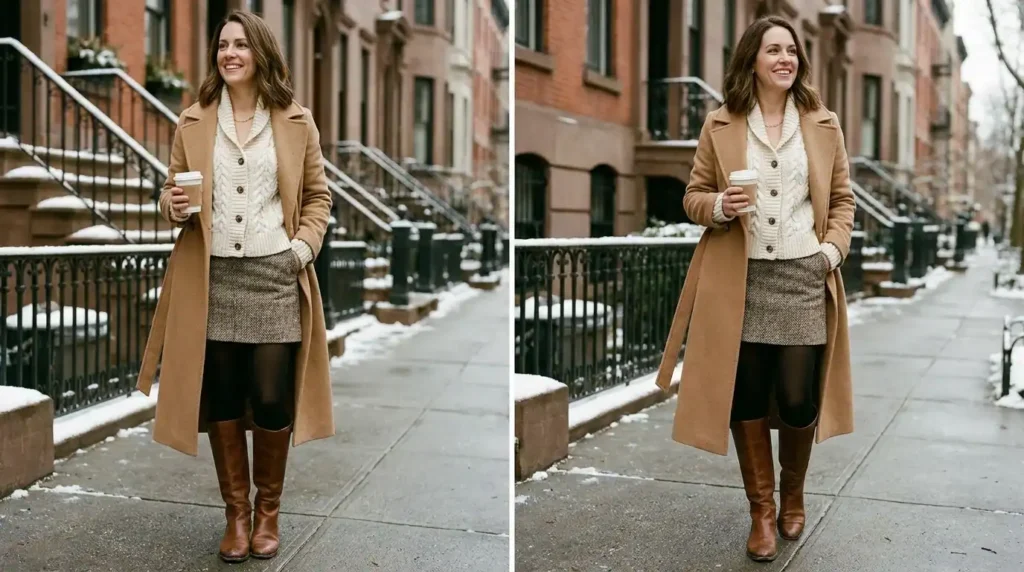
Introduction
You pull your favorite mini skirt from the closet in November. Then you put it right back. Cold legs, a bulky silhouette, an outfit that reads “confused,” not “chic” — this is the usual outcome. This guide fixes that with one clear layering order, built for women over 40 who want warmth without hiding the skirt under leggings or giving up on the piece entirely.
Most styling advice stops at “wear tights.” That’s the mistake. Tights alone leave a cold gap at the hip and thigh, right where the skirt rides up when you sit or walk. The fix is a true layering system: base, hosiery, mid-layer, outerwear, footwear, each one doing a specific job. Skip a layer and the whole outfit fails at 20°F.
Quick Answer: Layer a fitted thermal base top and bike shorts under the skirt, add 80+ denier opaque tights, stack a fitted top with a chunky sweater on your upper body, then close the look with a wool coat that falls past the skirt hem and knee-high boots. Seven steps, zero shivering. The single biggest insight: warmth comes from what covers the gaps, not from how heavy any one piece is.
Important Instruction for Winter Mini Skirt Outfit

Wardrobe Pieces
- A-line or straight wool-blend mini skirt. This cut skims the hip instead of clinging, so it layers over a base top without pulling tight across the stomach or thighs. A stretch-wool blend holds its shape through winter wear in a way thin cotton can’t. Wool-blend A-line mini skirt
- Fitted thermal base layer top. Tuck this under the skirt waistband, not under your shirt. It closes the draft gap at the hip that tights alone leave open. Thermal fitted camisole
- 80–100 denier opaque tights. The industry standard for everyday winter warmth sits at 80 denier; once temps drop hard, 100 denier-plus keeps legs covered without adding bulk at the ankle. 80 denier opaque tights
- Rib-knit fitted sweater: Wear this closest to your torso, under a bulkier layer. The fit stops fabric from bunching under a coat. Ribbed fitted sweater
- Chunky open cardigan or oversized sweater. This traps warm air between your base layer and your coat. Pick one long enough to cover the skirt waistband when you raise your arms. oversized chunky cardigan
- Wool or wool-blend long coat. Length matters more than weight here. A coat that falls past the skirt hem blocks wind at the one spot a mini skirt can’t cover. long wool coat women
Accessories & Footwear
- Knee-high or over-the-knee boots: These close the final gap between hemline and boot top, the exact zone where cold air sneaks in on a mini skirt outfit. Knee-high leather boots
- Wide cashmere or wool scarf: Wrap this high and loose. Body heat escapes fastest through the neck, so this piece does more work than a hat for total-body warmth. Oversized wool scarf
- Structured leather or suede gloves. Cold hands make the whole outfit feel colder than it is. Pick a pair with a slight cuff that tucks under your coat sleeve. leather gloves women
- Wide leather belt. Cinch this over the sweater and coat to define your waist. This is the trick that keeps a layered, over-40 outfit from reading as shapeless. Wide leather belt

Requirements Table for Best Winter Mini Skirt Outfit
| Item | Approx. Price Range | Where to Shop | Best For (Body Type/Season) |
|---|---|---|---|
| Wool-blend mini skirt | 45–90 | Amazon, Nordstrom | Pear/hourglass; deep winter |
| Thermal base layer top | 15–35 | Amazon, Uniqlo | All body types; sub-30°F days |
| 80–100 denier tights | 12–25 | Amazon, department stores | All body types; everyday winter |
| Chunky cardigan/sweater | 40–85 | Amazon, J.Crew | Apple/rectangle; adds volume up top |
| Long wool coat | 120–280 | Amazon, department stores | All body types; windy, wet climates |
| Knee-high boots | 80–220 | Amazon, DSW | Athletic/hourglass; icy, snowy days |
The Foolproof Layering Order for a Warm Winter Mini Skirt
Step 1: Pick a Skirt Fabric That Fights Wind, Not Just Looks Cold

Check the fabric tag before anything else. Wool, wool-blend, or a thick ponte knit blocks wind. Thin cotton or linen mini skirts do not, no matter how many layers you stack underneath. A skirt with at least 30% wool content holds a layering outfit together.
Common Mistake: Reaching for a summer cotton mini skirt because the color or print works for fall. Fabric weight decides warmth long before color does.
Pro Tip: Hold the skirt up to a light. If you see daylight through the weave, it needs a slip underneath, not just tights.
Step 2: Build Your Base Layer Before You Touch the Skirt

Put on a fitted thermal top and, if your skirt sits above mid-thigh, a bike short underneath first. Tuck the top into the bike shorts, not into the skirt. This step closes the cold gap at your hip before tights or the skirt go on at all.
Common Mistake: Skipping the base layer because “tights will handle it.” Tights cover the leg, not the waist and hip area where a mini skirt gaps most.
Pro Tip: Choose a seamless base layer. Visible seams under a fitted skirt ruin the smooth line you want at 40-plus.
Step 3: Choose the Right Denier Tights for the Temperature

Match denier to the thermometer, not to your tights drawer. Wear 50-denier tights for mild fall days, 80 denier for standard winter cold, and 100 denier or higher for anything below freezing. Pull them up high, past the natural waist, so no skin shows at the skirt’s waistband.
Common Mistake: Wearing 20-denier sheer tights in January because they match an outfit. Sheer tights add almost no warmth below 40°F.
Pro Tip: Keep one pair each of 50, 80, and 100 denier on hand. Rotate by the forecast, not by the outfit.
Step 4: Close the Gap Where Skirt Meets Tights

Check the point where your skirt hem meets the top of your tights when you sit down, reach up, or climb stairs. If skin shows, the outfit fails here first. Add a slip layer or choose a slightly longer skirt length to remove this gap entirely.
Common Mistake: Testing the outfit only while standing still in front of a mirror. Movement reveals every cold spot a static pose hides.
Pro Tip: Sit down in the outfit before you leave the house. Fix any gap now, not on the train.
Step 5: Layer a Fitted Top, Then a Bulkier Sweater on Top

Start with the rib-knit top closest to your skin, tucked into the skirt waistband. Add the chunky cardigan or sweater over it, left open or belted at the waist. This fitted-to-loose order traps warm air between the layers instead of letting it escape.
Common Mistake: Wearing two bulky sweaters stacked together. This adds bulk without adding real warmth and hides your waistline completely.
Pro Tip: Belt the outer sweater over the coat, not under it, to keep a defined shape through the middle.
Step 6: Add a Coat Long Enough to Cover the Skirt Hem

Choose a coat that falls at least two to three inches past the skirt hem. This single measurement decides whether the outfit reads as “winter-ready” or “under-dressed.” A wool or wool-blend coat blocks wind in a way that cotton trenches or thin puffers can’t.
Common Mistake: Wearing a cropped jacket or moto coat that stops above the skirt hem. This leaves a bare strip of skirt fully exposed to wind.
Pro Tip: Try the coat seated, not just standing, since hems rise several inches once you sit down.
Step 7: Finish With Boots That Seal the Warmth In

Pull on knee-high or over-the-knee boots last. The boot top should sit close to, or slightly overlap, the bottom of the skirt when you move. This closes the last cold gap in the entire outfit, from waistband to boot.
Common Mistake: Pairing a mini skirt with ankle boots and bare calves. This leaves the coldest part of the leg fully exposed.
Pro Tip: Size boots to fit over a thicker sock or thin leg warmer for extra-cold days, without looking bulky under the skirt.
Where Most Over-40 Mini Skirt Outfits Go Wrong
Mistake 1: Treating tights as the only layer. Opaque tights cover the leg but do nothing for the hip and waist gap under a short hemline. Fix this by adding a fitted thermal base top tucked into bike shorts before the skirt goes on, closing that gap at the source.
Mistake 2: Choosing a coat for looks instead of length. A cropped jacket over a mini skirt leaves a bare strip of fabric exposed to wind, no matter how warm the layers underneath are. Fix this by measuring the coat against the skirt hem before you buy, aiming for two to three inches of overlap.
Mistake 3: Stacking bulk instead of layering smart. Two thick sweaters plus a puffer coat over a mini skirt reads as shapeless, not styled, and still leaves legs cold. Fix this with one fitted base, one mid-weight knit, and one structured wool coat, then let the belt and boots define your shape.
Your Winter Mini Skirt Questions, Answered
Yes, opaque tights at 80 denier or higher replace leggings for most winter days. Add a fitted thermal base layer at the hip for extra coverage on sub-freezing days. Leggings work too, but they change the silhouette more than tights do.
Aim for 80 denier for standard winter cold and 100 denier or higher for freezing temperatures. Below 50 denier, tights add style but very little warmth. Fabric blend matters too; wool-cotton tights trap more heat than plain nylon at the same denier.
The coat should fall at least two to three inches past the skirt hem. This single rule blocks the wind gap that makes mini skirts feel cold in winter. A knee-length or longer wool coat works for nearly every mini skirt length.
Yes, fit and proportion matter far more than age for this look. A tailored A-line cut, opaque tights, and a structured coat read as polished at any age. The styling choices in this guide, not the hemline itself, carry the look.
Knee-high or over-the-knee boots close the gap between hemline and footwear, which keeps legs warmer. Ankle boots work on milder days but leave more calf exposed to the cold. Chunky loafers with thick socks offer a casual, comfortable alternative.
Author Bio: Sara is a fashion stylist and content strategist who covers cold-weather dressing, layering, and styling for women over 40.


